False eye strain is the appearance of misalignment when there is actually no misalignment. False strabismus may be inward or outward, or upward or downward. False strabismus is a condition that is more common in babies and young children.
Since the facial anatomy of babies and children is not fully developed, the nasal roots are flattened and the skin around the eyes is folded. For this reason, the eyes of babies or children appear to shift inwards.
This appearance gradually disappears as children grow and their facial features settle. In addition to these factors, the structure of the eyeballs in babies or children or the difference between the visual axis and the geometric axis of the eye may also cause children to appear to have strabismus .
İçindekiler
Causes of False Eye Misalignment
The appearance of false eye misalignment may occur due to the anatomical location of the eye and surrounding structures, the position of the eyeball within the orbital bones, the skin tissue called epicanthus on the part of the eyelids close to the nose that we see in babies, the wideness of the root of the nose, and the eyes being positioned closer or farther from each other than normal .
As babies grow and develop, the shape of the face and eyes settles and this false shift appearance disappears.
How is false eye strain diagnosed?
The first diagnostic method used to distinguish false strabismus from true strabismus is the evaluation of the reflection of light on the eye. When false eye strain occurs, the light reflections falling on the eye are parallel to each other.
For this reason, when the baby or child looks straight ahead, the light reflection falls directly on the pupils of the eye. In the case of true strabismus , light reflections will not be parallel to each other.
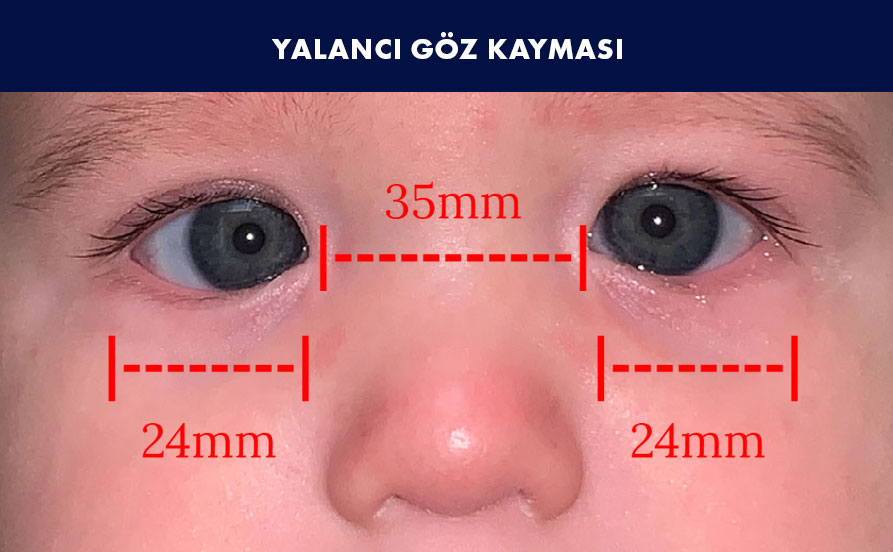
In addition, a detailed eye examination is required to diagnose false strabismus, especially when it comes to babies . Because some babies experience eye misalignment from time to time. For this, detailed eye examinations must be performed and it must be checked whether the vision rate is the same in both eyes. In addition, it is necessary to investigate whether babies or children have any problems with near or far vision.
In case of suspicion of strabismus , babies and children should be checked at frequent intervals. Even if there is no such suspicion, it is important to have eye checks every 6 months to protect eye health.
What we care about in the case of false eye deviation is that this misleading situation clouds the diagnosis of a real eye deviation . That’s why we perform more frequent routine checks on babies in whom we detect false eye strain .
For your questions about false eye strain, you can contact us via our Whatsapp contact line.

How is False Strabismus Treated?
There is no treatment for false strabismus . Because, as we mentioned before, this is a situation that arises from the fact that the facial anatomy of babies or children is not fully developed. However, what is important here is to determine whether babies or children actually have strabismus . Because real strabismus needs to be treated as soon as possible.
Although false strabismus improves over time, true strabismus progresses over time . For this reason, when strabismus occurs, intervention must be made as soon as possible.
If false eye misalignment seen in adults is caused by a problem related to the eyelids or orbit, eyelid or orbit surgery may be planned.
When is false eye strain corrected?
Especially in newborn babies, occasional eye misalignment is considered normal in the first 4 months. This condition usually resolves spontaneously after the 4th month. As babies grow and develop, the shape of the face and eyes settles and this false shift appearance disappears.
However, in some babies, eye misalignment may recur from time to time after the age of one. In this case, families should keep their children under control and consult an ophthalmologist without delay if the shift progresses. If false eye misalignment seen in adults is caused by a problem related to the eyelids, eyelid surgery may be planned.
Click to follow us on Instagram .