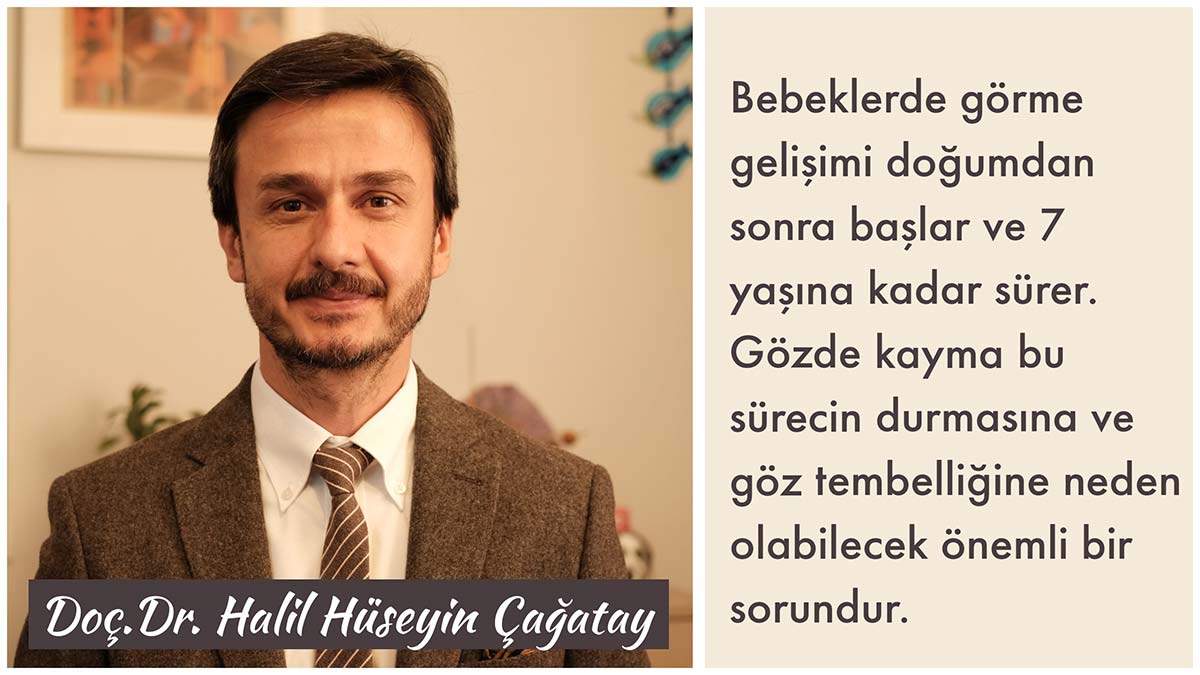
Unfortunately, eye misalignment is one of the problems we frequently encounter in one-year-old babies. Does your baby seem to have trouble focusing on a particular object? Or does your baby sometimes focus with one eye and shift the other? Eye development in babies occurs rapidly after birth, and the interruption of this process, which continues until the age of 7, causes the condition we call lazy eye. Therefore, eye wandering in babies in this period may be an important problem that should be addressed without being neglected.
Strabismus, a misalignment of the eyes, is one of the most common eye problems in children, affecting almost 4 percent of children under the age of 6. In babies, eye alignment and the ability of both eyes to focus on the same place develop in the first 4 months. This means that it is normal for babies to have strabismus and misalignment from time to time in the first 4 months. These occasional shifts are usually outward, inward shifting is less common in babies because their ability to focus with both eyes has not yet developed. However, as of 4 months, these occasional eye misalignments will stop. Eye strain in one-year-old babies is a condition that should not be neglected. The most important issue here is, is this a real shift or a pseudo-slip?
İçindekiler
- What does false slip mean? Is there a false slip in one-year-old babies?
- Strabismus is an important problem that causes lazy eye.
- What are the risk factors for eye misalignment in one-year-old babies?
- How is strabismus diagnosed?
- What options are there for the treatment of strabismus in 1-year-old babies?
- How Does Strabismus Affect Vision Ability?
What does false slip mean? Is there a false slip in one-year-old babies?
For children, especially those younger than one year old, their eyes may appear squinty-eyed, even though they are not actually like that. This is called false strabismus, or “pseudostrabismus” in Latin. This condition usually occurs when the child has a wide, flat nose or a fold of skin on the inner eyelid.

False glides are different from true glides. Some important points should warn you about true drift, which increases over time. False deviation occurs mostly in side gaze, while true deviation occurs when one eye moves inwards or outwards while looking straight ahead. If the misalignment always occurs in the same eye, it is more likely to be a true strabismus. In every way; It should not be forgotten that a detailed eye examination is required even in cases of suspicion of strabismus.

Strabismus is an important problem that causes lazy eye.
Strabismus affects vision because both eyes must focus on the same point together to see properly. If a person’s eyes are properly aligned during childhood, their eyesight develops well. However, if the eyes are not aligned, a condition called amblyopia can develop. This is when the misaligned eye has poorer vision.
What are the risk factors for eye misalignment in one-year-old babies?
Eye disorders such as cerebral palsy, hydrocephalus, high hyperopia, high myopia, premature birth, and having a family member with strabismus are risk factors for the development of eye misalignment in one-year-old babies. However, in many patients, deviations or eye disorders may occur without any of these risk factors. For this reason, it is important for all babies to have regular eye checks after birth until the age of 7.
How is strabismus diagnosed?
Strabismus is diagnosed during an eye exam. Evaluation of the eyes and vision should be done in the pediatrician’s office at every well-child visit. However, if your child shows signs of strabismus or other eye conditions at any age, a full eye exam should be performed by an ophthalmologist. The tests performed in this examination can be summarized as follows.
- Measurement of eye numbers
- The ability of the eyes to focus individually and track objects
- The ability of the eyes to move in 9 directions of gaze
- Red light reflection test
- Cover test
- Prism covering test
- Number measurement after teardrop eye examination and evaluation of the retina layer of the back of the eye.
What options are there for the treatment of strabismus in 1-year-old babies?
Treatment options may vary for each patient. For example, if hypermetropic eye disorder is detected in a child with introversion, glasses treatment is required. In addition, if the same eye always slips, the healthy eye can be covered at certain times. In addition, in cases such as a sudden onset of nerve paralysis, toxin injection can be made into the eye. Let’s not forget that if there is a real strabismus, this situation will not go away on its own over time. However, some occasional outward shifts, for example, may resolve spontaneously. However, leaving this task to time can definitely be done with a specialist ophthalmologist. And early treatment can prevent permanent visual impairment.
For your questions about eye strain, you can contact us via our Whatsapp contact line.

How Does Strabismus Affect Vision Ability?
In normal vision, both eyes target the same point. Our brain converts the two images coming from our eyes into a single, three-dimensional (3D) image. In this way, we can understand how close or far something is from us (called depth perception).
When one eye is out of alignment, each eye sends a different signal to the brain. In a young child, the brain learns to ignore the image of the misaligned eye. Instead, it perceives the image of the straight or better-seeing eye. As a result, depth perception may be affected.
Last word; We closely monitor the development of all your baby’s sensory organs. Eye and vision development is one of the most important parts of this development. Let’s not forget that; Vision constitutes 80% of memory. In other words, children learn easier and better by seeing. Therefore, it is important for every baby to undergo regular detailed eye examinations. The information in this article does not replace an eye examination.
Click to follow us on Instagram .