Vision develops rapidly after the newborn period, especially in the first year. Children reach the visual capacity of a healthy adult when they are approximately 7 years old. After birth, both the eye and the brain undergo physiological and anatomical changes.
Vision development appears to be an extremely important process. For this reason, any situation that will harm or disrupt this development should be intervened as early as possible. It is very difficult to restore possible vision loss that may occur if early intervention is not made. For this reason, it is considered to be extremely important to monitor whether eye development continues in a healthy way during childhood.
In our country , eye examination in children is included in the screening programs implemented by the Ministry of Health starting from the birth of the child. After birth, the first eye examination should be performed by the pediatrician.
After this, there is no need for an eye examination until the newborn period is over. However, as vision develops rapidly after the newborn period ends, it is useful to have an ophthalmologist examined at regular intervals. It is recommended that every baby and child have regular eye examinations, even if there is no problem or doubt about eye health .

İçindekiler
- When is Eye Examination Done in Babies?
- How to Perform a Pediatric Eye Examination?
- Eye Diseases Occurring in Children
- Symptoms to Pay Attention to in Babies and Children
- Treating Eye Diseases in Childhood
- Eye Distortion in Babies
- Eye Circles in Babies
- Do Visual Defects in Children Affect Daily Lives?
- Eye Examination in Children Between 2 and 5 Years Old
- My Child Has Hypermetropia / Astigmatism / Myopia, Is It Normal?
- Does Premature Birth Increase the Risk of Eye Diseases?
- My Child Has an Eye Defect. Will the Defect Increase as He Gets Older?
When is Eye Examination Done in Babies?
As we have mentioned before , eye examination in babies should be performed first after birth. The first examination during the newborn period is generally performed by the pediatrician on the 15th day . Although the examination is carried out by a pediatrician , it is also beneficial to be examined by a specialist ophthalmologist within the first 3 months if the necessary possibilities are available.
After this examination, there is no need for a repeat examination until eye development accelerates. After the newborn period, the first eye examination should be performed when the baby is 6 to 9 months old. This examination can be performed by a pediatrician , but if possible, it is recommended to be performed by a specialist ophthalmologist .
During this examination, it is evaluated whether there is strabismus , whether the baby is followed with two eyes, the back of the eye and whether the baby’s eye degree is present. Moreover; If parents suspect that the baby has conditions such as eye wandering , strabismus, whiteness of the pupil, the baby’s inability to follow objects with both eyes, or eye tremors before or after this period ; You should definitely consult a specialist doctor. Even if there are no complaints, it is recommended that children have regular eye examinations once a year.

How to Perform a Pediatric Eye Examination?
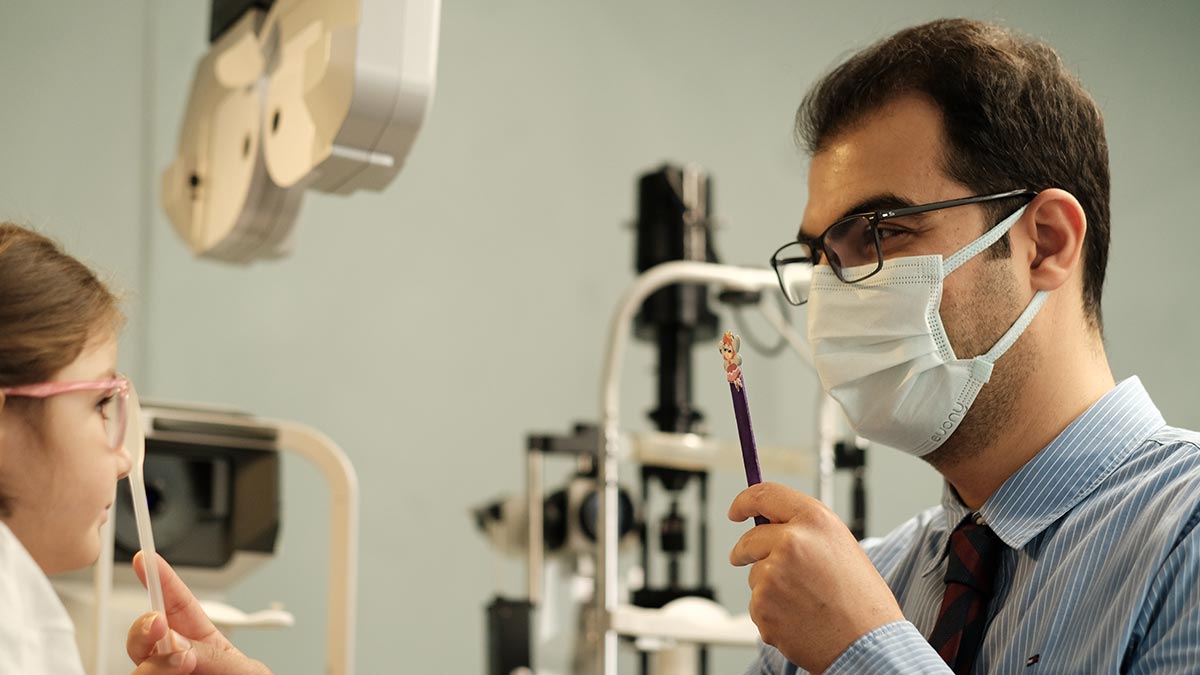
Children’s eye examinations are performed using different methods, unlike adults. The following practices are performed during the eye examination to be performed by a specialist physician:
- Performing eye measurements to accurately detect possible eye disorders
- Detailed evaluation of the eye in terms of infection (since infections can cause many eye diseases, it stands out as an issue that needs attention)
- By looking at light reflexes, it is possible to determine whether there is a problem in the response of children’s pupils.
- Determining whether there are anatomical defects in the eyelids or eyes
- Investigation of the presence of cataracts due to congenital causes
- Investigation of the presence of congenital eye hypertension
- Reflection of red light from the pupils
- Whether the eyeballs are parallel and move together

Eye Diseases Occurring in Children
When it comes to eye diseases in children, it is possible to talk about many disorders. Eye diseases seen in children can be listed as follows;
- neonatal conjunctivitis
- Prematurity retinopathy
- Bacterial/Viral/Allergic Conjunctivitis
- tear duct blockage
- Congenital cataracts or glaucoma in infancy or early childhood
- The transparent layer at the outermost part of the eye, called the cornea, has a cloudy structure.
- Various retinal diseases
- Eye problems that develop due to various metabolic and genetic diseases
- Strabismus
- Tumors that develop within the eye that have the capacity to be life-threatening
- Nystagmus (Eye tremor)
- Various eyelid diseases, especially droopy eyelids
In addition, the most common eye problems in preschool children are as follows;
- Myopia , Astigmatism and hyperopia
- A significant difference between the two eyes (anisometropia)
- Strabismus
- lazy eye
Symptoms to Pay Attention to in Babies and Children
It is important to pay attention to symptoms that may indicate eye diseases in babies and children. By following these symptoms consciously, it will be possible to detect eye diseases early. Symptoms of eye diseases that should be paid attention to in infancy and early childhood can be listed as follows;
- Constant itching sensation in the eyes
- Extreme sensitivity to light
- Difficulty focusing on an object or following a moving object
- Disordered eye parallelism or limited parallelism of the eyes
- Persistent redness problem in the eyes
- Unilateral or bilateral watering of the eyes
- Drooping or sagging of the eyelids
- Inflammatory discharge from the eyes, excessive crusting
- The appearance of a white reflection in the pupil, which normally has a black appearance
In addition to these symptoms, turning the head instead of the eyes when looking at any object in preschool children also indicates eye disorders . In addition, squinting when looking at a distant place, experiencing balance problems and gait disturbances may also be symptoms of eye problems.
Treating Eye Diseases in Childhood
Many eye problems that can be diagnosed in childhood and treated successfully using appropriate treatment methods can cause more serious problems in the future if they are not noticed. Eye diseases that occur in childhood can become more complicated with age.
As a result, the effects of the disease may be much more profound and serious complications, including permanent vision loss, may develop. Therefore, it is extremely important to diagnose eye diseases at an early age and apply appropriate treatments.
For example , amblyopia , a very common eye disease , can only be treated if it is detected at an early age. Although it is much more difficult to treat amblyopia with advancing ages , the probability of successful treatment also decreases.
The main factors that cause amblyopia to occur are known as high refractive errors, a significant difference between the refractive errors in the two eyes, and strabismus. Detection of these conditions can only be achieved through examinations performed at childhood ages.
Eye Distortion in Babies
Eye strain in babies is an extremely important issue that should never be neglected. Even in case of doubt, it is recommended to have an eye examination. Eye strain in babies ; It can be up-down, diagonally or inward-outward. In these cases, a detailed eye examination must be performed. Factors that cause eye misalignment can be listed as follows;
- Neurological disorders
- Retinal anomalies
- lazy eye
- Low visibility
- eye disorder
- congenital cataract
Treating eye misalignment in babies is as important as diagnosing it. If the problem is caused by strabismus, first of all, false strabismus and true strabismus should be distinguished. Following this distinction , eye misalignment in babies can be successfully treated with methods such as prismatic or special prescription glasses or surgery .
The most important factor causing amblyopia in children is known as the presence of an eye degree called strabismus or refractive error. Early detection of these conditions can only be achieved through regular eye examination. Although it is not certain , it is possible to talk about the existence of a genetic predisposition for disorders such as misalignment and amblyopia .
Therefore, if such disorders are observed in the family, it is recommended that children be given extra care in this regard. Children with a family history of such eye disorders should have regular eye examinations starting from infancy.
Eye Circles in Babies
Eye popping is a very common condition in babies. Eye drooping usually develops due to 2 reasons. The first of these; It is the occurrence of pink eye due to respiratory tract infection .
In this case, there is no need for an extra eye treatment. Another cause of eye drooping is known as congenital lacrimal obstruction . It is observed that babies with this condition experience burring and watering attacks starting from the 1st month. Eye drooping caused by this condition is a significant problem and requires treatment.
Do Visual Defects in Children Affect Daily Lives?
Visual defects in children directly affect daily lives. It is observed that children with eye defects, especially those who establish social relationships with their peers during infancy, develop less social skills than their peers.
On the other hand, it seems that visual impairment in children directly affects school success. In addition, it is possible to say that children have some difficulties in communicating with their classmates. For this reason, children with suspected visual impairment must be examined by a specialist physician.
Eye Examination in Children Between 2 and 5 Years Old
The following tests are performed during eye examination for children between the ages of 2 and 5;
- Strabismus examination
- Reflexes against light
- Red light reflection test applied to the pupils of the eyes
- Vision test (reading the letters on the vision card at a distance of 6 meters or following objects visually)
- Detecting eye number using photo scanning methods
- fundus examination
For your questions about pediatric eye examinations, you can contact us via our Whatsapp contact line.

My Child Has Hypermetropia / Astigmatism / Myopia, Is It Normal?
In babies and children, eye measurements are considered normal within certain limits and do not require the use of glasses. For example, up to 6 degrees of hyperopia can be seen in babies up to 1 year old . These high values decrease as children grow older and reach values that can be seen in an adult at approximately 5-6 years of age.
Children’s use of glasses is specially evaluated. The specialist physician will evaluate many factors and choose the most appropriate method. For example, in cases where the degrees of the two eyes are different, personalized decisions are made.
Does Premature Birth Increase the Risk of Eye Diseases?
According to statistics , the risk of retinopathy in premature babies is higher than other babies. If the baby was born before the 35th week, it is recommended to be examined 4 weeks after birth.
During this examination, it would be appropriate to perform fundus evaluation in case premature retinopathy has developed . It is recommended to re-check and follow-up at appropriate time intervals depending on the patient’s condition.
My Child Has an Eye Defect. Will the Defect Increase as He Gets Older?
One of the most curious questions about eye diseases in children is whether the defect found in childhood progresses over time. It is critical that some eye defects are detected in childhood. Over time, children’s defects may progress and become seriously difficult in daily life.
For example, amblyopia is a condition that needs to be treated in childhood. As we get older, treatment becomes more difficult and the success rate decreases. In addition, some eye diseases that occur in childhood can cause permanent eye damage later in life.
Click to follow us on Instagram .