
Myopia ; It is known as an eye defect in which close-range objects are seen clearly but distant objects are seen blurry.
In people with myopia , the shape of the eyeball causes the refracted light to collect in the front part of the retina instead of the retina. This causes the problem of blurred vision at long distances.
İçindekiler
What is Myopia?
Myopia , known as distance vision defect, can be defined as an eye defect that causes distant objects to be seen blurry while close objects are seen clearly.
Myopia degree ; It varies from forms that do not require treatment to forms that seriously affect vision. Myopia , which generally begins in children between the ages of 6 and 13 , can increase rapidly, especially during adolescence, when the body develops rapidly. In addition, the disorder can also occur in adults.
What Causes Myopia?
The causes of myopia stand out as a subject that many people wonder about. There are two parts of the eye called cornea and lens, which are responsible for focusing images.
The cornea is a dome-shaped tissue located on the outer surface of the eye. The lens has a transparent bicovenx structure. Both of these areas, which are responsible for focusing in the normal-shaped, healthy eye, have a smooth and perfect curvature like a marble surface.
In a healthy eye with normal curvature, the cornea and lens refract the light coming into the eye and allow it to focus on the retina located at the back of the eye. However, if the corneal surface or lens surface is not smooth and properly curved, light cannot be refracted properly and refractive errors occur.
Nearsightedness generally occurs when the eyeball is longer than normal or the cornea has an excessively curved structure. In these cases, the refracted light focuses on the front of the retina, instead of being focused on the retina. As a result of this situation, a blurry image is obtained for distant objects. Some factors; It increases the possibility of myopia defect . Myopia risk factors can be listed as follows;
Genetic factors : Myopia is known as a defect that is extremely prone to genetic transmission. Having myopia in one of the parents increases the likelihood of myopia in the person. In addition, if both parents have myopia, the likelihood of myopia increases even more.
Working at close range and excessive reading : People who spend a lot of time in front of the computer during the day, reading or writing are considered to be in the risk group for myopia. Spending time in front of the computer or reading books for long periods of time, especially during childhood, is considered to be among the main reasons for the development of myopia . For this reason, it is beneficial to limit these types of activities, especially for your children under the age of 13.
Environmental conditions : According to the results of some studies on the causes of myopia, it has been concluded that limited time spent outdoors is among the factors affecting the development of myopia.
For your questions about myopia, you can contact us via our Whatsapp contact line.

What are the symptoms of myopia?
Symptoms of myopia in adults can be listed as follows;
- Difficulty seeing distant objects, blurred vision.
- Squinting the eyelids to see distant objects clearly
- Eye fatigue and the resulting headache
- Difficulty in vision, especially when driving at night
Myopia is an eye defect that is generally diagnosed in childhood. It is possible to list the symptoms encountered in children with vision impairment of distant objects as follows;
- The need to look closely while watching television or playing the computer, or the need to sit in the front row while listening to lectures at school
- excessive blinking
- Delay or difficulty noticing distant objects
- Frequent rubbing of eyes
- Squinting when looking at distant areas
Eye Diseases Related to Myopia
The likelihood of some eye problems is much higher in some adults who have difficulty seeing far away or in children who have myopia but have not received treatment. The tissues on the long eyeball become stretched and thinned, creating a suitable ground for various eye problems. Eye diseases that develop due to myopia are as follows;
Strabismus : It is a common disorder in childhood in which the eyes look in different directions.
Lazy eye : In cases where there is a difference between eye numbers, individuals automatically start to use their less visible eye less. Development is incomplete in the underused eye and therefore laziness is observed. It is seen in childhood and is a treatable disorder.
Glaucoma : It is a serious eye disease characterized by an increase in intraocular pressure, popularly known as glaucoma .
Cataract : It is an eye defect that occurs due to loss of transparency in the eye lens. It is a disorder that is more common, especially in older individuals.
Retinal detachment : This condition, which occurs when some areas on the retina become separated from the blood vessels that provide nutrients and oxygen, is a problem with a high probability of vision loss that requires urgent treatment.
How is myopia treated?
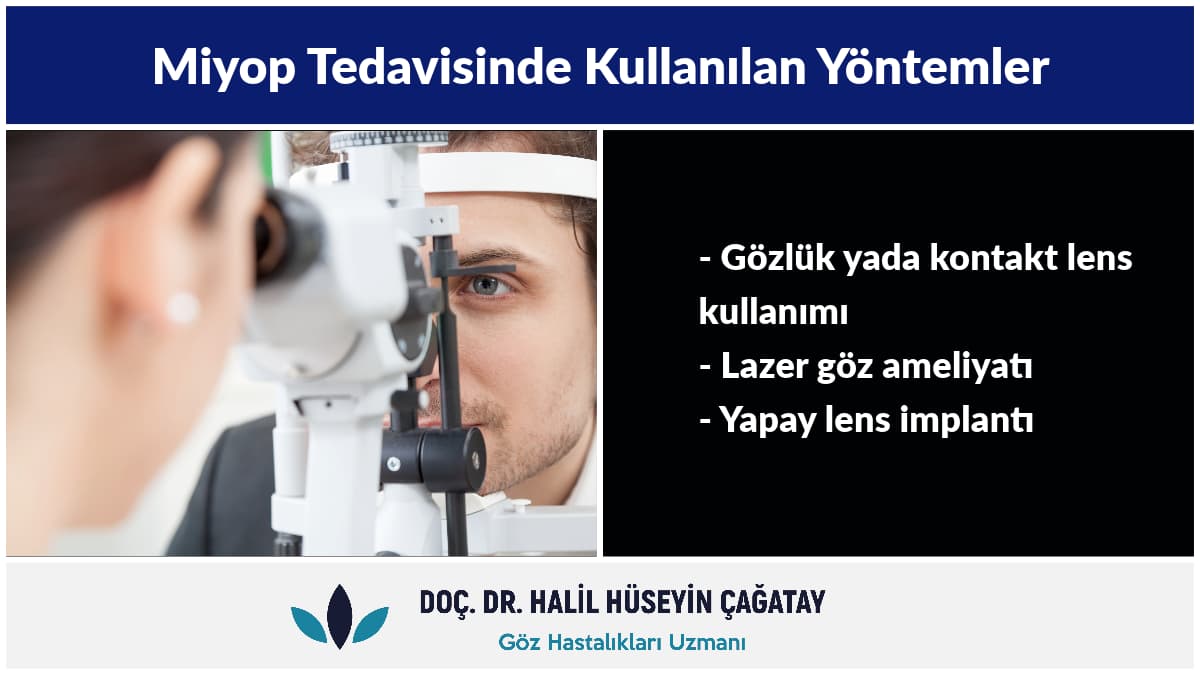
Questions such as how myopia is treated and what are the treatment methods are frequently asked. Myopia is an eye defect that can be treated as long as the correct treatment methods are applied. The methods used in the treatment of myopia can be listed as follows;
Use of glasses or contact lenses : Contact lenses or glasses can be used to ensure that the eyes can focus distant objects on the retina. The first treatment method applied to people with myopia is usually glasses.
However, some people use contact lenses to eliminate aesthetic concerns and provide a clearer and relatively wider field of vision. This is a completely individual choice and people can consider both options.
Contact lenses are products that cover the eye and are placed directly into the eye. For this reason, hygienic use is extremely important in protecting eye health and preventing conditions such as infection. Use of glasses or contact lenses; Depending on factors such as people’s life habits and myopia degree, it can be recommended for continuous use or during certain activities.
Laser eye surgery : This method, popularly known as eye contouring , can be explained as an intervention performed by changing the shape of the corneal layer of the eye. It is definitely not recommended for use in individuals whose eye development continues. For this reason, it is not a treatment method applied to children. Additionally, it does not eliminate myopia for life. Individuals who have laser surgery ; If the factors that cause myopia are not taken into consideration, myopia development may occur again. But this is usually a process that takes many years.
Artificial lens implant : Artificially produced lenses are placed inside the eye to ensure correct focusing. In older ages, it can be done by removing the person’s thickened lens and replacing it with an artificial lens, but in high myopic patients, an artificial lens can be placed while their own lens remains.
Click to follow us on Instagram .