
Lazy eye is a disorder that directly affects the patient’s life, especially social relations and personal success. Early diagnosis and treatment is essential to prevent current and possible future negative situations.
İçindekiler
What is Lazy Eye?
Amblyopia , commonly referred to as “lazy eye” , is, in its most general definition, a condition of decreased visual acuity. “Seeing” occurs thanks to the coordination of the eyes and the brain and after a series of complicated processes.
If the neural impulses received from the right and left eyes cannot come together into a single image for different reasons, the image perceived by the brain becomes weak and this causes the condition called amblyopia . Lazy eye can be seen in one eye or in both eyes.
Who Gets Lazy Eye?
Although amblyopia , like most eye diseases, occurs in childhood, it is a disorder that the patient will carry into his or her old age if not treated. Although it varies by country and region, the average incidence is between 2% and 3%.
What are the symptoms of lazy eye?
Symptoms indicating the presence of amblyopia can be seen from birth. The underlying cause of many of these symptoms is the child’s attempt to sharpen his vision:
The child tries to look at objects more closely at the outside world by lifting his chin up or tilting his head towards his right or left shoulder. Similarly, it is also possible for the child to try to open his or her eyes more, or to squint or close them, or to blink or rub them frequently. Eye tremors , especially strabismus , are signs that indicate that amblyopia exists/will occur.
How Do Children with Lazy Eye See?

Children with amblyopia can easily distinguish and see an object from other objects. However, the image quality is low in contrast and somewhat unclear. Of course, this varies depending on vision ability.
What are the types of Amblyopia and why is it seen?
Amblyopia is generally classified as follows according to the causes of its occurrence:
Strabismus Amblyopia: Strabismus is the condition that most commonly triggers lazy eye. In the presence of strabismus, visual acuity decreases as the patient’s eyes shift.
Refractive Amblyopia : The presence of refractive error in the eye(s), in other words, situations where the patient is required to wear glasses, are among the main reasons that trigger lazy eye, such as strabismus . (In addition, if the gap between the degree of refractive error in the two eyes is widened, visual acuity decreases. This condition is called anisometropic amblyopia.)
Deprivation Amblyopia: In this class, also known as deprivation amblyopia, some eye diseases for which treatment is started late cause amblyopia . Bleeding within the eye, drooping eyelids , presence of cataracts (congenital), etc. Diseases can be given as an example of this.
Organic Amblyopia: As the name suggests, organic causes cause amblyopia in this class. To explain, optic nerve hypoplasia, myelinated nerve fibers, etc. in the eye or components of the visual system. Due to pathologies, the patient’s visual acuity decreases. Ten out of every hundred patients diagnosed with amblyopia are classified as organic amblyopia.
Idiopathic Amblyopia: This is the class in which amblyopia is observed in one eye, although there are no organic problems or amblyogenic factors.
For your questions about lazy eye, you can contact us via our Whatsapp contact line.

Lazy Eye Treatment
The reason for the emergence of amblyopia directly or indirectly affects the treatment. First of all, the main problem causing lazy eye must be treated. Surgery is required for cataracts or droopy eyelids .
If there is a refractive error, glasses should be given. Strabismus should be treated with glasses or surgery. It is especially important to start treatment early in order to prevent strabismus amblyopia from becoming permanent. Apart from all these, it should also be known that it is difficult to regain vision in the case of organic amblyopia.
The pillars of amblyopia treatment are the physician, the patient and their family, because the process requires solidarity. An eye examination performed effectively and without delay is the beginning of the journey. After the physician diagnoses amblyopia , the aim is to activate the relevant eye because in this way, neural connections can be relieved from weakness and eye-brain coordination can be achieved.
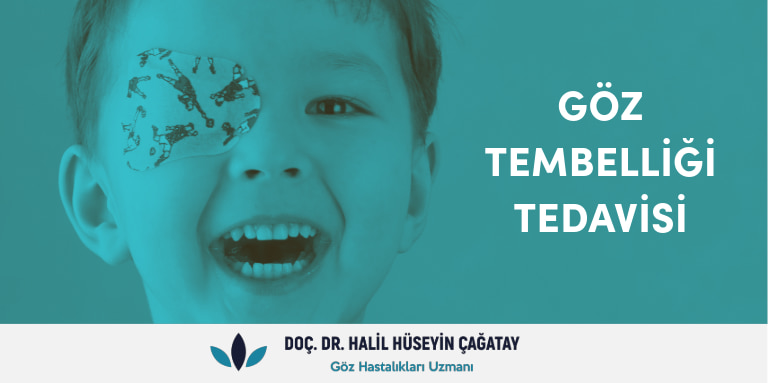
Treatment for Children: Closing the child’s eye that does not experience amblyopia for the periods recommended by the physician during the day is a widely used amblyopia treatment. In some cases, the eye with amblyopia can also be closed – although less frequently than the healthy eye. A sterile, non-allergenic, soft material should be used to close the eye.
As the child grows and begins to react to having his eyes covered, the support of the family becomes important. For example, in such a scenario, it would be beneficial to direct the child’s attention to another direction. However, if the child insists on the discomfort of having his eye covered, alternatively, he can be switched to drop treatment in the healthy eye. These types of drops act as a kind of covering material by blurring the vision of the healthy eye.
Although it varies depending on the type of amblyopia, the doctor may also recommend that the child use glasses.
In order to increase visual acuity, patients can also receive CAM (Cambridge Ambliopic Vision Stimulator) treatment in the hospital. This treatment method provides beneficial results in strabismus amblyopia and especially in anisometropic amblyopia, but it cannot replace closure treatment. As part of the treatment, the patient must look at the discs in a special device. These discs contain black (high contrast) lines and complete a left-right rotation in 60 seconds. The quantitative and qualitative characteristics of the lines vary depending on the patient’s condition.
Treatment for Adults: Neurovision treatment can be applied to the patient in later years for amblyopia that was not treated during childhood . It is aimed to increase visual acuity with this treatment method, which should be applied to the patient for a period of time and routine determined by the physician (approximately three days a week, half an hour), for two months.
To achieve this goal, the focus is on the patient’s perception of tasks loaded on the computer and/or images with different contrasts. As detection occurs, the patient provides feedback using the mouse. Feedback is repeated until it is error free. The effect of this treatment in adults is not clear. Even if vision improves in some patients, it may return to its previous state after treatment is discontinued.
What to Know About Amblyopia
The period with the highest success rate in amblyopia treatment is the first four years after birth. The rate of success in the following three-year period is satisfactory. Strabismus or droopy eyelids , which can be noticed from the outside , prompt parents to consult a physician, but amblyopia may not cause symptoms. In this context, the most important point that parents should know is that they should have their children’s eye scans at certain periods after birth (between 6 months and 1 year of age, between 3 and 5 years of age, and at 7 years of age), even if no complaints are observed.
Lazy eye , which was diagnosed in childhood and not treated , causes problems not only in terms of decreased visual acuity, but also in social and psychological aspects when the patient reaches adolescence/adulthood. Keeping this fact aside, it is very important to treat amblyopia during the critical period.
Remember: Starting amblyopia treatment late will prolong the treatment time and directly reduce its success!
Click to follow us on Instagram .