
In people with healthy and normal vision, the rays coming into the eye from outside focus on the fovea (yellow spot) and create a clear image. In individuals with hyperopic defect, these rays are collected in the back part of the fovea/retina instead of the fovea, depending on various factors.
The main reason why these rays collect behind the retina is explained as the eyeball being smaller than normal or the lens surface of the cornea not having enough power to refract light. Hyperopia , a disorder that can be seen in both adults and children and infants, is an eye condition that can be treated.
İçindekiler
What is Hypermetropia?
Hypermetropia can be explained as an eye defect that occurs when the rays refracted by the cornea (the front layer of the eye) and the eye lens fall on the area behind the retina . As a result of this situation, the image on the retina is blurred. In hyperopic eyes, either the front-back length of the eye is shorter than normal, or the lens or cornea does not have enough light refractive power, or both conditions occur together.
Hypermetropia , one of the most common eye defects , is generally known as nearsightedness but also causes problems in distance vision. In low-grade hyperopia , individuals generally adapt to distant vision and no problems arise in distant vision. However, they may have difficulty seeing up close. In high-grade hyperopia , it will be difficult to see far away.
Who Gets Hypermetropia?
The majority of babies are born with their eye development not yet complete. For this reason, they are born with mild hyperopia . Hypermetropia , which tends to increase until about the age of 7 , begins to decrease after the age of 7 and disappears with the completion of the developmental processes.
However, in some people, the hyperopia problem does not disappear and continues. If necessary treatments are not performed, it may also cause the development of eye diseases such as amblyopia or strabismus .
The eye’s adaptability is high, especially during childhood and adolescence. People do not have any problems with seeing far away due to this ability of the eye. There is even a possibility that there may be no problems with near vision from time to time.
However, with advancing age, especially in the 40s, the natural lens in the eye begins to seriously lose its flexibility due to the decrease in the elastin fibers in it. The natural lens, which loses its flexibility, also loses its adaptability that allows us to see up close more easily. As a result, hyperopic people begin to experience blurred vision, both near and far , more clearly.
It is very important for children to have regular eye examinations in order to make an early diagnosis of amblyopia that may be caused by hyperopia . Detection of amblyopia, hyperopia or other eye defects can be achieved through these regular examinations.
During these examinations, it may be necessary to apply drops to the eye in order to make a more accurate measurement. Examination using drops is preferred, especially in young children, children with eye misalignment , and people with hypermetropia in one eye.
For your questions about hyperopia, you can contact us via our Whatsapp contact line.

What are the symptoms of hyperopia?
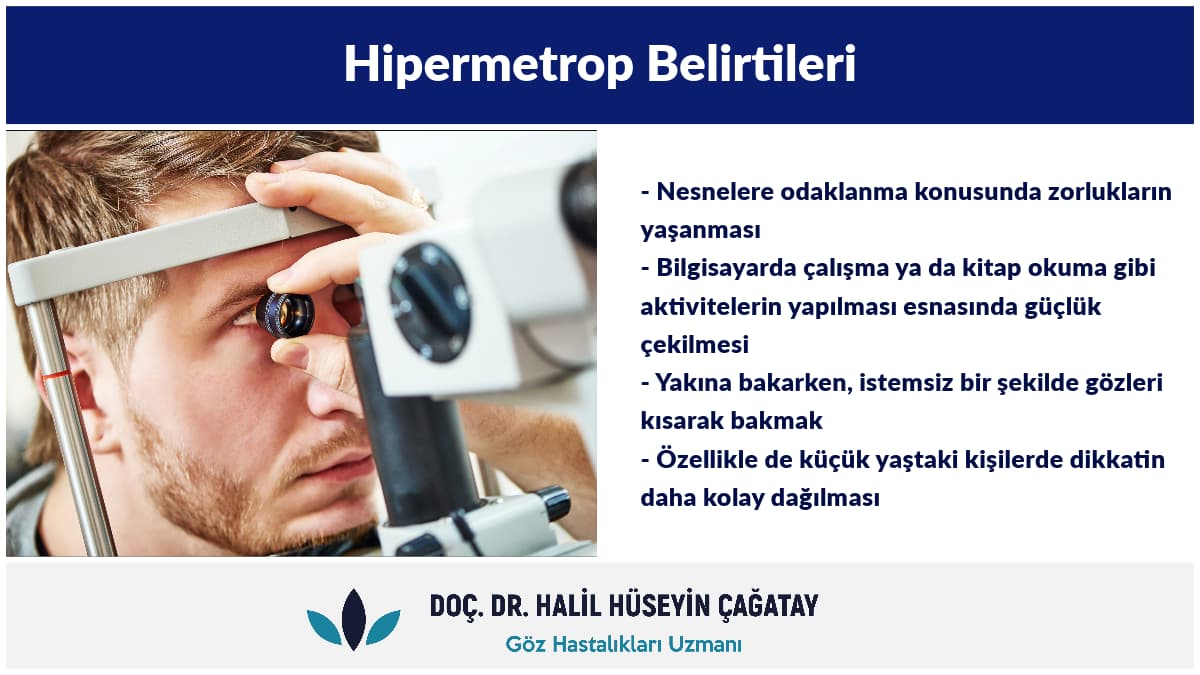
One of the most common symptoms of hyperopia , regardless of age, is difficulties in seeing up close. As the degree of hypermetropia increases, vision problems occur at long distances. The most common symptoms of hyperopia can be listed as follows;
- Having difficulties focusing on objects
- Difficulty performing activities such as working on the computer or reading a book
- Involuntary squinting when looking at close up
- Easily distracted, especially in younger people
- Hypersensitivity to light
- Periodically recurring pain in the eye or head
- Inward shifts in the eye area in children
How is hyperopia diagnosed?
Hyperopia ; It is a disorder that can be easily diagnosed after a comprehensive eye examination by a specialist physician.
During the examination, the individuals’ eye degrees are first measured and then their vision levels are checked. Afterwards, if the doctor deems it necessary, the eye drops are measured again after the patient waits for a while.
How is hyperopia treated?
In the treatment of hyperopia, the aim is for the rays to fall on the fovea. It is possible to divide the methods used in treatment into three headings: use of glasses, use of contact lenses and surgical intervention.
The most commonly used method in the treatment of hyperopia is the use of glasses. Convex lenses, which have properties that increase the light refractive power of the eye, are used in glasses prescribed to individuals with hyperopia . In addition, contact lenses have the same function as glasses and are among the frequently used methods in the treatment of hyperopia .
With the development of presbyopia starting from the age of 40 , people begin to have more difficulty in seeing up close. In these cases, either distance and near glasses are prescribed separately, or progressive (multifocal) glasses are prescribed, in which individuals can see both distance and near with a single eyeglass. Multifocal contact lenses may also be prescribed to suitable patients.
The most permanent method among hyperopia treatment methods is known as surgical treatment. Laser method or intraocular lens applications are used in surgical intervention. With laser treatment, hyperopia is corrected and clear vision is aimed, both near and far, without glasses. Laser treatment is not recommended after the age of 35. Intraocular lens application can be performed at older ages.
Click to follow us on Instagram .